Key numbers for the fridge
Save these in your phone tonight. When something happens, nobody remembers a number.
Why now
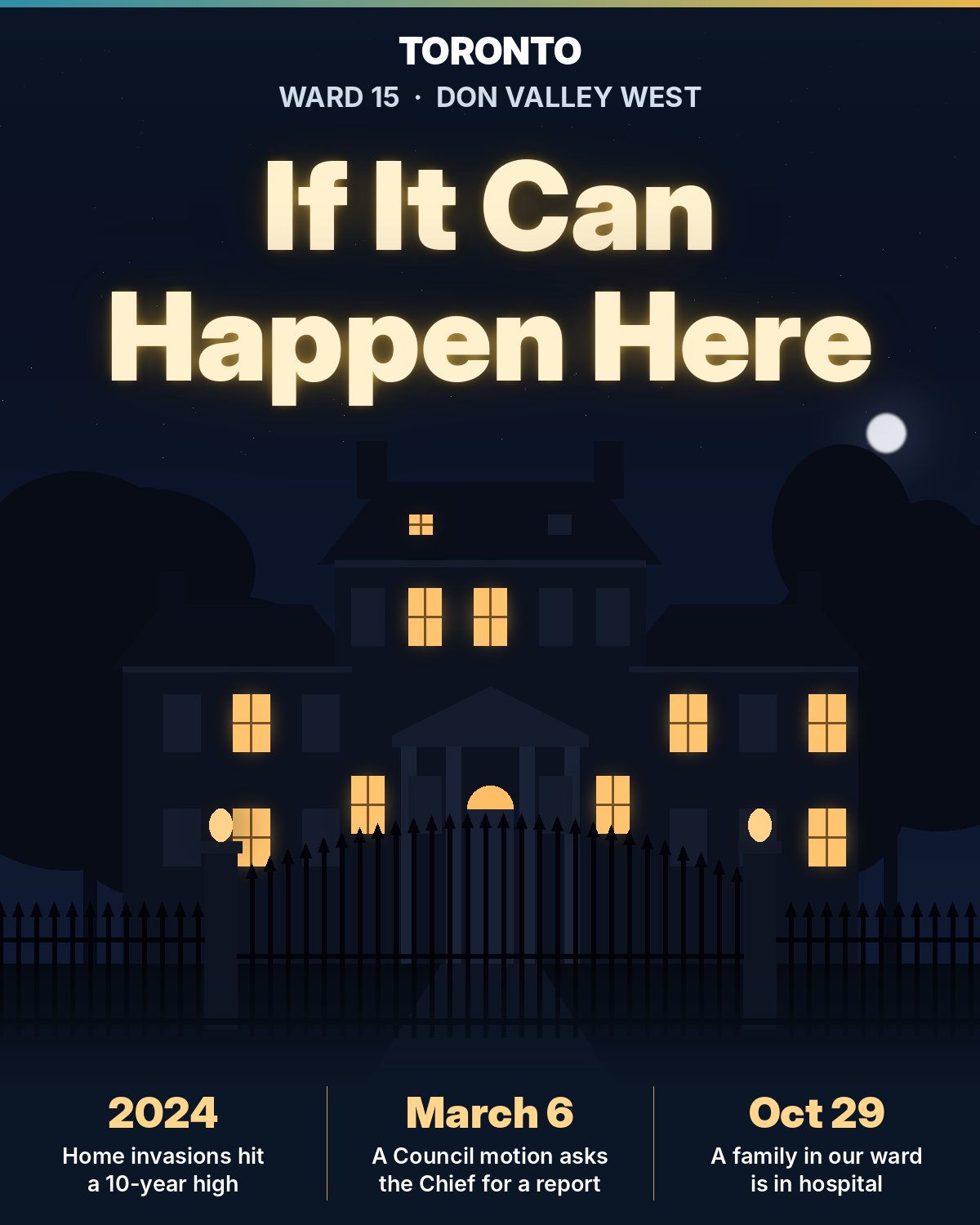
On October 29, 3 masked people with handguns and a hammer broke into a home near Bayview and Lawrence. A father and his 2 adult daughters were shot, and his wife was hurt.
It happened on one of the most secured streets in Toronto. Home invasions in our city hit a 10-year high in 2024, and police have tied many of them to organized car theft rings that recruit young people to do the dangerous work.
No guide can stop a determined, armed crew. That's the job of police, courts and every level of government, and we'll keep asking them for a plan. What a guide can do is make our homes harder targets, help us think clearly in the worst moment, and get us the right help afterwards.
Ontario's emergency management works in 5 parts for every hazard, from ice storms to pandemics: prevention, mitigation, preparedness, response and recovery. We're using the same 5 here, plus one more that every good plan needs: keeping daily life running while you recover.
Prevent it. Lessen it. Prepare for it. Respond to it. Recover from it.
Prevent
Prevention means stopping it before it starts. Thieves pick the home that looks easiest, darkest and quickest, so our job is to look like more trouble than the house next door. Tick what you've done. Your ticks stay on this device only.
Around the house
Your car
Apartments and condos
Mitigate
Mitigation means making it less harmful if it happens anyway. We can't promise nobody will ever try our door. We can make sure that if they do, they get less time, less loot and less of a chance to hurt anyone.
Prepare
Preparedness means knowing what you'll do before you need to. A plan made at the kitchen table on a calm afternoon is the one you'll actually follow at 3 a.m. Everyone in the home should know it, including the kids and the grandparents.
It's 2 a.m. and you hear glass break downstairs. If you've already agreed on the safe room, the code word and where the phone is, nobody has to think. You say the word, everyone moves, the door locks, and you're talking to 911 within a minute. That calm minute is what the kitchen-table plan buys you.
Respond
Response means what you do in the moment. If it happens, your only job is to get everyone out alive. Things can be replaced. People can't.
If someone is in your home
- Don't confront them. Get everyone to the safe room and lock the door.
- Call 911. Say your address first, then "someone is in my house."
- Stay on the line, stay quiet, and stay put until police tell you it's safe.
- If they demand car keys or valuables, hand them over. Your car isn't worth your life.
What helps police most
- How many people, and their height, build and voices.
- Clothing, shoes, masks, gloves and anything they carried.
- The vehicle: colour, make, plate, and which way it went.
- The time. Check your doorbell or camera footage and don't delete anything.
A full description of what you saw helps far more than a single detail. It's what helps police find the right people.
If you come home and something's wrong
A door open that you closed, a broken window, lights you didn't leave on: don't go in. Go somewhere safe, like your car with the doors locked or a neighbour's house, and call 911 from there.
Recover
Recovery means getting back on your feet. Afterwards is when people feel most alone. You're not. Here's who to call and what to do, in order.
Young people, parties and weapons
Toronto Police describe the 3 suspects in the October 29 home invasion as about 20 years old, and police have tied crimes like this to rings that recruit young people to do the dangerous work. Our kids need a plan too, and so do we as parents.
For young people
- If you see a gun or a knife at a party, leave right away. Don't argue, film or try to take it.
- Get somewhere safe, then call 911. A weapon in a crowd is an emergency.
- Text a parent your family's code word. It means "come get me now, no questions tonight."
- Tell a trusted adult afterwards. You won't be in trouble for telling.
- If anyone offers you fast money to "just drive" or "just hold something," that's how these rings recruit. Say no and tell someone.
For parents
- Agree on a code word this weekend, and promise to pick up with no questions that night.
- Ask your kids, calmly, whether they've seen weapons at parties or online. Listen more than you talk.
- Promise them they won't be punished for telling you. That promise is what keeps them talking.
- If they've seen something, report it to Toronto Police with them, at 416-808-2222, or 911 if anyone is in danger.
- For support, young people can call Kids Help Phone at 1-800-668-6868 or text 686868, any time.
Toronto Crime Stoppers paused all tips on October 21, 2026, after a breach at its software provider exposed about 180,000 tips and nearly 15,000 names. Until a safe anonymous line returns, reports go to Toronto Police directly. That isn't anonymous, which is why it helps for a parent to make the call alongside the young person. We've asked every level of government when a safe, anonymous way to report will be restored.
Leave. Get safe. Call. Tell someone.
Keep life running
Emergency planners call this business continuity. At home it means the kids still get picked up, the medication still gets taken and the dog still gets walked, even if you spend the night at the hospital or the police station.
Police tape is across your front door and you're giving a statement at midnight. Your neighbour already has a key and already knows the dog's dinner time. Your daughter's school pickup is covered. Your medication list is in your phone. Nothing about that night is easy, but none of it falls apart either.
What we're asking every level of government
Households can make themselves harder targets. Breaking the networks behind these crimes takes all 3 levels of government, working together.
Will violent home invasions be an early priority for the new Council, and will the police report Council asked for in March be made public?
Ontario runs the courts and the Crowns who argue bail. What will change so people charged with violent home invasions aren't back on our streets?
Ottawa writes the bail and sentencing rules, guards the border where handguns come in, and oversees the ports where stolen cars go out. What's the plan on all 3?